Home bakers struggle with pricing their baked goods. They’re always afraid it’s “too much.”
When you only bake for family, friends, and co-workers, you just consider the cost of ingredients. Now as a home baker, you have to think about labeling, packaging, insurance, fees, and labor.
There will be customers who scoff and ask you, “this much for a cookie?”
Yes and no.
In this blog post, I’m going to walk you through how I priced my chunky cookies at $6 and how I stopped getting pushback on my home bakery prices.
This blog post may contain affiliate links, which means I may earn a commission if you make a purchase through these links at no additional cost to you. The content provided is for informational and entertainment purposes only and should not be considered professional advice.
Please read the Disclaimer Policy for more information.
What to Consider When Setting Your Home Bakery Prices
Where you are and who you serve are major qualitative factors to consider.
Although I live in Southern Maryland where it’s pretty rural and farm-y, it’s close to Washington DC. So, a lot of commuters live here, meaning prices are driven up.
I recently heard that New York City bakeries have been charging up to $8 a cookie! So, big city means big prices — even when you’re an hour away from one.
Conversely, I have heard from home bakers in smaller towns say that there’s no way they could sell a cookie for more than $2 simply because of their economy.
So, there’s definitely nuance. But, I did set my prices to $6 a 3.5-ounce cookie out of nowhere.
I created a spreadsheet that helped me set my home bakery prices. This is what to consider:
- Cost of ingredients used
- Weight of ingredients used
- How much of each ingredient is used to make 1 cookie
- How much each ingredient costs when making 1 cookie
- What is the total cost of your packaging and labeling material for 1 cookie?
- How many cookies and I make per hour, including packaging and labeling?
- What is my wage per hour? (Even if you’re not actually paying yourself)
- What would be my credit card fees for 1 cookie?
- What percent of the final cost do I want to set for overhead?
- What percent of the final cost do I want to set for profit?
You also don’t want to set your final home bakery price to what you get because you might get $3.85 for your chocolate chip cookie, $2.49 for a snickerdoodle, and $4.73 for a double chocolate chip.
Also consider possible deals and discounts you want to offer your customers in the future. So, your final cost may be $5 or $6.
Which by the way, these aren’t my costs. I put in random numbers!
Anyway, onto the good stuff — how to deal with pushback on your home bakery prices.
Show! Don’t Tell.
Back when I learned how to write essays in school, it was drilled into me that you have to state the obvious all the time because you can never assume that the reader knows what you’re talking about.
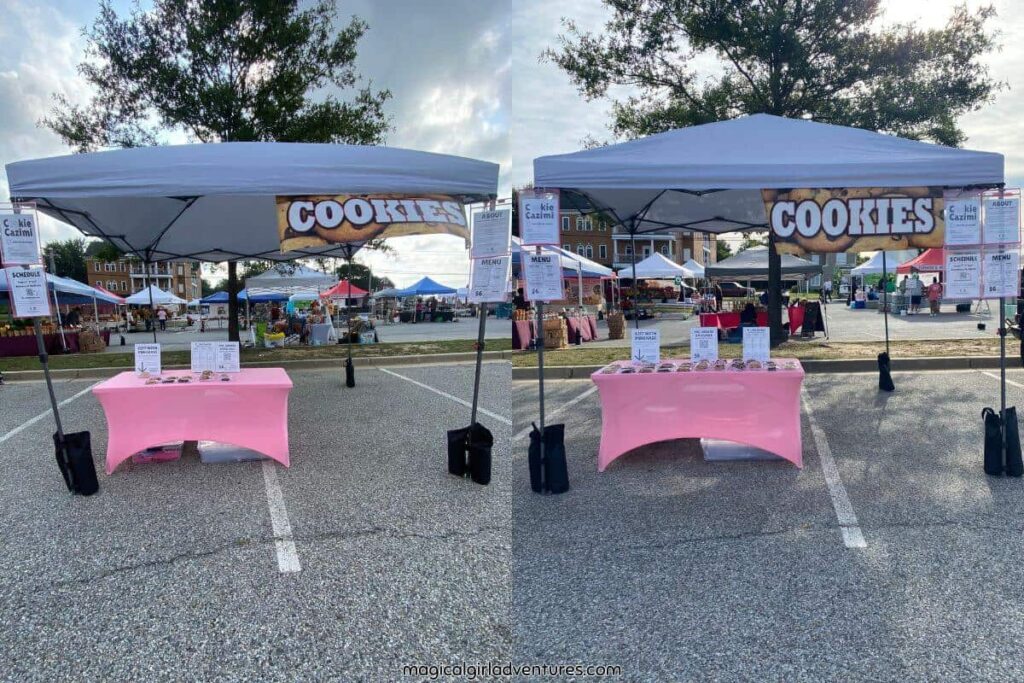
For my farmers market booth, I tie these pink dry-erase pocket sleeves with my marketing copy to introduce my home bakery and products to passerbys because people don’t like being surveilled or harped on.
They just want to look.
And I simply make it easy for them to stand in front of my tent without nervous — “JUST LOOKING!”
I explain the meaning of my business name, the ingredients I’ve chosen to use, and the flavors I offer.
If I don’t tell my customers that Cookie Cazimi is about celebration, good luck, and opportunity, or that I use more butter for my chunky cookies than other chunky cookies typically have for better flavor, then they’re not going to understand why they should buy from me at all.
Customers want to have a sense of your expertise before experiencing it.
Generally, people know that home bakers love baking. But, then what? Why not go to another stand?
Show them who you are! Without talking to them… haha.
I highly encourage you to write some stuff up and hang up signs (and these acrylic signs on your table). They’re really effective!
Comparison is the Thief of… Uncertainty
On one of my last days at the farmers market in 2025, a man came up to buy a cookie because he really wanted something sweet to hold him over, but mentioned that that $6 is a bit steep for one cookie.
I pointed him towards the $4 items I had at the time, which were my 2-ounce ginger molasses and hot cocoa cookies.
Then he pushed back on me saying that, “well, these [$6 cookies] seem like a better bang for my buck.”
Which is the point! How funny that he sold himself to me in a way.
When customers have options, it gives them power to make a decision. Because people love feeling like they have options!
And yes, they could give you the old “I’ll come back after I look around” in hopes of finding a cheaper baker. But, that’s their prerogative and right.
At the same time, you’re also going to have customers who come back despite there being cheaper bakers because they love your stuff specifically.
More is More
I don’t believe in giving discounts from a place of desperation to make a sale. When my customers buy 5 chunky cookies, they can get 1 free.
And you know what? Not everyone is taking it.
I’ll have 2 sales a market with people taking advantage of it. Because devaluing your baked goods doesn’t make people want to buy more.
Give your customers free things because it’s fun and a gesture of goodwill. They’ll sort of feel rewarded for buying more. And it’s fun to be bad and eat a lot of cookies!
From time to time, I’ll run a gift-with-purchase deal for orders valued at $18 or more because I like to bake! And I wanted to make a lot of mini cinnamon crunch coffee cakes.
So, you can offer deals and bundles as one way to combat price pushback, but don’t go at it from a scarcity angle, okay?

What if it doesn’t clock?
The latest Justin Bieber meme plays through my head a lot.
The pop singer is confronting paparazzi for stalking him (because they are) and says, “You don’t get it. It’s not clocking to you. It’s not clocking to you that I’m standing on business, is it?”
I think it went viral because the statement doesn’t really make sense. But, that added to the memorability. Basically, he’s saying that they don’t understand and never will. And sometimes, that’s just what it is.
There will be people who simply won’t be your customers.
That is not a sign to lower your prices. Let them go.
There’s a saying in marketing that if you’re selling to everybody, then you’re selling to nobody.
Because if you’re marketing generic details that speaks to everybody, no one will feel like they’re being talked to specifically.
As a result, they won’t buy.
Just stand your ground. Whether you use my spreadsheet to calculate what to charge for your cottage foods or do it manually yourself, you know what you need to make on a baked good to not run yourself into the ground — financially and mentally.
And you know what? When I first started at the farmers market, I had the most expensive cookies. But, within the next few months, I noticed other home bakers charging $6-7 for their baked goods. Not because they realized they could “get away with it” but because I was there to show them that you can charge what you’re worth!
Because it costs more than just ingredients to run a home bakery.
Concluding How to Combat Home Bakery Price Pushback
As you can see, your home bakery prices aren’t really about the baked good itself. There’s so much more to consider when you’re selling to the public as a cottage food baker.
I know you’re not baking to become Bezos rich. I mean… there are better ways to do it.
You love to bake! And burnt out people are not good bakers. Charging what you’re worth will keep you going so you can spread deliciousness to your communities.